Published: August 04, 2010
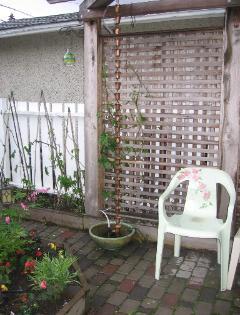
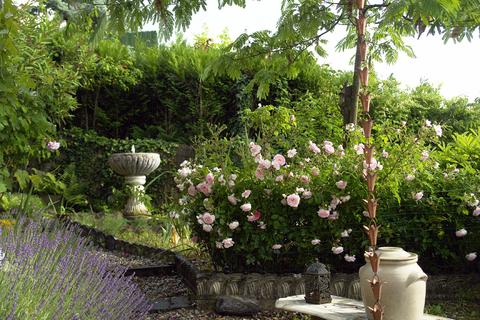
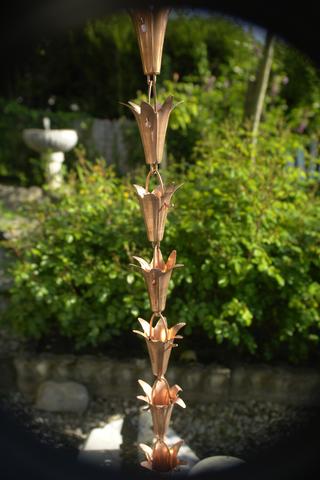
Many rain chain owners have chosen to incorporate their rain chains into water reclamation schemes - this practice is also known as "rainwater harvesting." These systems make rain chains much more valuable than just being simple decorative downspouts. Two popular ways of harvesting rainwater are rain barrels and rain gardens.
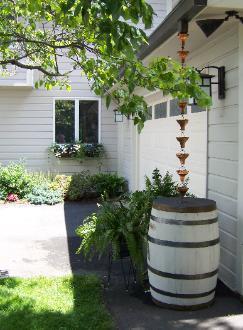
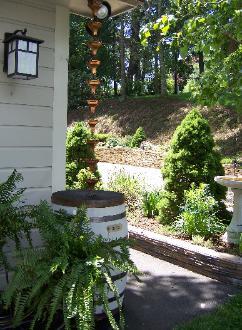
Rain barrels are a great way to store rainwater for later use around the house and garden. Rainwater is superior for plants and flowers compared to water from the tap, so it is popularly used amongst garderners who know. Since a rain barrel can draw a lot of attention to itself, it's also more aesthetically pleasing to have a rain chain feeding the barrel than a conventional gutter downspout.
In addition to the reasons already mentioned, rainwater harvesting is also an important way that we can all reduce storwater runoff. Stormwater runoff is a big problem in regards to pollution in urban settings. This type of pollution occurs because there is a high prevalence of impervious surfaces which make it so that rainwater doesn't soak into the ground where it falls. Instead it flows along these surfaces until it is channeled into drains. Along the way, the stormwater can pick up debris, chemicals, and many types of other pollutants where they ultimately get carried into lakes, rivers, streams, wetlands and coastal waters. This can be harmful to the local waterbodies we use for fishing, swimming, and drinking water.
When water is saved for use in the yard (such as in a rain barrel) or funneled into a rain garden, then water can soak back into the ground in a natural way, where it can be filtered by ground soil and vegetation. This allows these harmful toxins to be filtered out by the time they make their way back to inland and coastal water-bodies. Although the impact of one household reducing runoff can seem small, this is exactly where it must begin. And as a critical mass of people in an area engage in these types of practices, there can be a real impact on the improvement of water quality.
Published: July 30, 2010
Many people choose to incorporate their rain chains into water reclamation schemes - also called "rainwater harvesting." These systems make rain chains much more valuable than just being simple decorative downspouts--they also can help to reduce stormwater runoff, which can be harmful to our water supply. Stormwater runoff is a big problem in urban settings because there is
such a prevalence of impervious surfaces that rainwater doesn't soak
into the ground where it falls. Instead it flows along these surfaces
until it is channeled into drains. Along the way, the stormwater can
pick up debris, chemicals, and many types of other pollutants where
they ultimately get carried into lakes, rivers, streams, wetlands and
coastal waters. This can be very taxing on local waterbodies we use
for fishing, swimming, and drinking water.
Two popular ways of harvesting rainwater are rain barrels and rain gardens:

Rain barrels are a great way to store rainwater for later use around the house and garden. Rainwater is also superior for plants and flowers compared to water from the tap. A rain barrel can often be made more aesthetically pleasing having a rain chain feeding the barrel rather than a conventional gutter downspout. Rain barrels can help manage runoff be keeping it from ending up in the drain.
Rain gardens are also an effective way to reduce stormwater runoff. Rain gardens are a shallow depression placed in the low part of a yard where water can collect during storms. Often native plants can be used in the rain garden which can be fed by the stormwater. This system helps water back into the ground where it falls rather than being channeled to drainage systems. Many people have their rain chains feed water into their rain garden.
Whether water is saved for use in the yard (such as in a rain barrel) or funneled into a rain garden, both of these methods have been proven to help reduce stormwater runoff.
Published: June 02, 2010
One of the most frequent questions we get regarding rainchains is
if a rain chain can be successfully used without the benefit of a
gutter. The simple answer is, in most cases, they can be used. But,
all situations are different and for a rain chain to work without a
gutter, the water would have to come down from the roof in a vertical
manner to a point, such as a corner or valley of a house. The rain
chain would have to positioned or hung beneath the flow to act
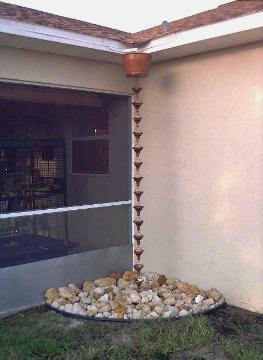
efficiently and catch the rain water. Here is an example of one customer's solution:

One of our customers created his own solution to this problem that not
only looks great but also works well. Unfortunately, we do not sell
the pots or buckets, but I have seen them at local hardware stores such
as Home Depot or Lowes.
Another question we get regularly is regarding homes in the
Southwest which have canales which usually have a closed end. These
canales come in many forms; but most of them usually force the water to
go horizontally instead of vertical; which is what a rain chains needs
to work efficiently. I have customers who have successfully drilled a
hole in the canale which enabled them to hang a rain chain
successfully. The bucket system mentioned above has also been used
used by several satisfied customers. There are many different
ingenious ideas for rain chains, and they do not all have to include a
traditional gutter system.
When rain chains are used in cold, icy climates, do they have to
be removed because of ice buildup? This is another popular question
that is asked frequently. Many people choose to take them down and put
them back up in the spring. But many also choose to leave them up and
watch the beautiful ice sculptures that form on and around the chain.
While you do take a chance when there is a heavy buildup, that the
chain may break; we have gotten very few complaints regarding this.
Please go back to our testimonial link to see the beautiful ice
scuptures that several of our customers have shared with us. One lucky
lady even won our Mothers Day Contest with her interesting picture of
ice surrounding her rain chain.
Don't forget our Gift Certificates in any denomination for those
wedding, birthday, or graduation gifts this summer. Rain chains make a
perfect hostess gift while traveling this summer. Also remember
Father's Day is June 20. Surprise that man in your life with one of
our lovely rain chains!
Published: April 30, 2010
At Rain Chains Direct, we aim to be the obvious choice when it comes to buying a rain chain. In the last few years, the availability of rain chains has exploded. There are hundreds of places to buy them online as well as multiple large retailers now selling them. So with such a large selection to choose from, why should you choose Rain Chains Direct?
Probably the biggest reason is quality for your dollar. When we say quality, we mean 100% pure copper rain chains designed is beautiful contemporary styles. Many of the chains you see appearing on the market are “copper” as in copper coated, but these are not 100% copper and are a cheaper way of making rain chains. Copper is expensive and it’s tempting to cut costs by using other materials, but for us this is not an acceptable option.
Copper is a 100% recylable material, in that it can be re-used over and over in many different products without affecting it’s essential properties. We are committed to being an environmentally smart company and this is one of the ways we achieve this. We are also completely paperless, by the way!
In addition to the all copper commitment, our chains are all 8.5 feet long. Another unfortunate trend in rain chains today is the 6 foot rain chain. Many sellers are trying to convince customers this is a full length rain chain. It’s not. Unless you have a very tall receptacle, these chains will come up short.
Furthermore, because we are a very efficient company, we are able to keep our costs much lower than many competitors. We pass these savings on to our customers. That is why we have some of the best prices on the web, while still offering a quality product. You can definitely pay more for a rain chain, but it is unlikely you will be getting higher quality. In fact, many of the comparable rain chains on other sites sell for almost double!
We also pride ourselves in top-notch customer service. We get back to you quickly and we love to answer questions and solve problems.
Lastly, we believe in the philosophy of giving a percentage of our profits to efforts that help make a better world. We believe this will be standard in the future for businesses. Currently we are giving 10% of all our profits to Edutopia, which is an organization that is working to improve public education in smart ways that work. We are proud to support them.
For all of these reasons we believe Rain Chains Direct is the best choice all around for your rain chain purchase. And if you don’t feel that is the case, please tell us why—we love feedback and use it to constantly improve our business practice!
Rain Chains Home
Published: February 19, 2010
I thought I’d write some fun facts about the copper we use in our rain chains. Copper has been called “man’s infinite metal.” It’s extreme durability can be seen in items discovered by archaeologists dating over 10,000 years ago—items in good condition. Copper and its alloys are used for everything from monetary coins to space technology.
Copper is everywhere around us, in and around the walls of our homes, in telephone equipment, in electrical devices and wiring, and in plumbing. It is also used to build all manner of things including computers, microwaves, and many household appliances. It is estimated that approximately 1500 lbs of this metal will be used in the course of a modern individual’s lifetime.
Copper can be recycled infinitely. Internet resources indicate that copper available worldwide approaches six trillion lbs. and it is estimated that only 12 percent of that resource has actually been mined with nearly all of this still in circulation because of its higher rate of recycling than that of any other metal—this is why copper is a sustainable substance.
Each year in the United States, almost as much copper comes from recycled materials as is newly mined. When we excluded newly mined copper, we find that almost 3/4 of all copper used in industry is from copper scrap. Over half of this scrap is new, which is left over from production of new copper items. The remainder or old scrap comes from everything up to and including ancient plumbing.
Copper is the only resource in which the United States is totally self sufficient in terms of it’s use equaling it’s production. Just another reason to feel good about buying a rain chain from Rain Chains Direct—you’re also being sustainably smart!

Published: January 13, 2010
Recently we at Rain Chains Direct have decided to give 10% of all our net profits to Edutopia. Edutopia is a not-for-profit organization whose aim is to foster what works in education. Our system of education is woefully out of date in many areas and under-utilizes many technological advances that are a mainstay of modern businesses. Edutopia looks at the challenges of today’s educational system from a comprehensive and multi-dimensional perspective, in an effort to improve and bring new and effective approaches to the table.
As the owner of Rain Chains Direct I have a personal affinity for high-quality education, as I believe it is the cornerstone of a free, moral and prosperous society. It is from this belief that I am happy to support Edutopia, and as a customer, you can know that your dollars are not only going to get you a quality product, but are also going to support a very important cause.
Sincerely,
Scott
Published: October 06, 2009
Rain chains are not only for downspout replacement. They can also be a unique, tranquil addition to any garden setting. The Japanese had several uses for rainchains. They used them to accent architecture, garden decor and temples. They also used these chains to direct water away from their roofs, and collected this water for later household usage—they were “Green” before the term got popular.
Various types of collection bins can also be used for water collection. Rain barrels have also become popular to pair with rain chains as well. Collecting containers are made of a variety of materials including plastic, metal, stone, ceramic, and wooden-type materials. Another good idea is to hang rain chains in an area where there are potted plants or other foliage that could benefit from the rain chains. Rain chains do not have to be solely hung from gutters. They can also be hung from trees or used in conjunction with fountains or water wells. They are also becoming increasingly popular for usage on houses without benefit of traditional gutters. More and more ingenious ideas are springing from the simple concept of rain chains and we encourage our customers to share their creative ideas that they have used for their rain chains.
Published: August 23, 2009
Rain chains have gained so much popularity over recent years. More and more people are realizing how functional and beautiful rain chains can be. Rain chains or Kusari doi in Japanese, have been around for hundreds of years. The Japanese have used their roofs in conjunction with rain chains for means of water collection for years. They, in turn, use this rainwater for many household purposes. There are many Japanese churches and buildings that use a very large type of rain chains for decoration. Rain chains on churches and cathedrals are becoming more and more popular. The link-stye chain is more like the original Japanese chains than the cup-style chains, although many prefer the cup-style chains for various reasons. The cup-style chains seem to have less spoashage than the link-type, although both types have the potential for some splashage if the rainfall is heavy enough. Many customers have had success with the gutter reducer, which acts like a funnel to help direct the water down through the chain. Many people like to use rain barrels or other types of receptacles to compliment their rain chains. Some worry that wind may cause their chains to blow around, but usually this is not a problem. If this is a concern, tent-like stakes can be used or even fishing wire can help to stabilize the chain. Having the chain hang into a receptacle with rocks around the bottom of the chain can also help to anchor the rain chain. Rain chains can also be used on roofs without the benefit of gutters. As long as there is an area on a roof where water streams down, a rain chain can be used successfully.
As I have stated in previous blogs, I have a partial chain hanging from one of my trees. I also have chain hanging on a shepherd’s hook in my garden. Rain chains add so much charm and personality to any garden, from the sight of the rain water cascading down through the chain to the delightful, peaceful sound of rushing water going from cup to cup. They are quite easy to attach to the gutter with each chain having its own attachment piece. Most chains can be shortened or lengthened by means of pliars. The hammered cup and the double loop chain, both, need to be cut and soldered for shortening or lengthening the chain.
All our rain chains are 100% copper and over time, and dependent upon different weather conditions, can form a lovely patina to be enjoyed for a very long time to come.

Published: August 23, 2009
Hydrangeas are, next to Pansies, my very favorite flower. My mother had a whole side of the house with nothing but hydrangeas, in pinks, whites, lilacs, blues and corals. It wasn’t until just recently that I realized it was not merely luck that made these hydrangeas so lovely…….it was location, location, location! It was the perfect soil mixed with the perfect amount of shade and sun that made these flowers so perfect. And each year, they would come back with ease and little work by my mother…..only bigger and more vivid with color. She even put some in large pots and they were also a success. The Hydrangea, common names Hydrangea and Hortensia, is a genus of about 70-75 species of flowering plants native to southern and eastern Asia and North and South America.
Hydrangea flowers are produced from early spring to late autumn. They grow well in flower beds, but I have also had much success with them in large pots. I have not, until recent years, had much success with Hydrangeas. My memories of my mom’s beautiful flowers lead me to a quest to find the perfect location in the many homes I have lived in over the years Alas, I have found a place in the home I live in now. I have them in pots and in the ground. Obviously. the large oak trees that they share their space with, have given them a perfect home. My automated sprinklers give them a drink of water every other day and they get only morning sun. I am careful to “dead head” them regularly and I fertilize them every couple of months with Color Star . This year I had one pot that boomed all winter long. I brought it in and put it on my window sill until the flowers seem to begin to wilt. They are beginning to bloom again this spring and they will give off beautiful blooms until the Fall and if I am lucky again this year, may have a few that will last through the winter.
I am adding a rain chain in the little corner where my hydrangeas seem to flourish. I will put a basin under the rainchain. Rainchains add so much charm to the garden. I have them in my back yard, and now, I am putting them in my front flower beds, also. I even have a partial chain hanging from one of my Crepe Myrtle trees.
Rain chains make a perfect gift for yourself or for a fellow gardener. With the arrival of Spring, which brings Easter, Mothers and Fathers’ Day, birthdays. graduations and weddings. you could not give a more perfect gift. Also, do not forget our Gift Certificates, which can be given in any denomination. How much easier could gifting get?
Check out our other blogs for ideas regarding rainchains and many types of plants and flowers. We even have a blog for container gardening.

Published: August 23, 2009
Rainchains, or Kusari Doi, which is the Japanese name for these decorative home and garden accents, are a lovely, yet funtional alternative to the drab, ugly downspout. All our rainchains are 100% copper and are all appoximately 8.5 feet in length. For multi-story homes, which may require longer lengths, most of our chains can be joined together or shortened at any point by means of pliars. The double loop and the hammered cup with ring may require cutting and soldering to change the length or add to another chain. We have a lovely basin (14.5 in. in diameter) that can be paired with any rainchain for a wonderful accent to the garden. If a chain is too short and you do not want to buy another chain, you can get a taller receptacle made of copper or terra cotta, which will hide the fact that the chain is too short. You can also get a link of copper chain from the hardware store and attach it to the shorter chain and give it some length. I have had customers tell me that this helped solve the problem and it looked great. Decorative rocks can also be added around the bottom of the chain, whether it is cascading into a receptacle or just going to the ground. The rocks give it a finished look and help anchor the chain. Fishing line or tent-like stakes can also be used to anchor the rainchains at the bottom, if there is a need.
We have many sizes and types of chains to fit all weather situations. The large cup-style chains, i.e. large copper pails and the aged square cups (which are 4″ in diameter) are suggested for areas where there is heavy rain. While all rain chains will have some splashing, these two seem to handle large amounts of rainfall the best. If you do not have heavy rainfall and you basically want a rainchain for aesthetic reasons, any of our small cup-style chains will work well. Many of our customers prefer the link-type chain. We have the double loop and the traditional link chains which seem to appeal to many builders. We also sell gutter reducers which work well with all our chains and help to direct the water down through the chain.
There are many other ways to use rainchains other than the traditional alternative to the downspout. Some have used rainchains in conjuction with pumps and fountains, creating a unique alternative to traditional landscaping. A creative imagination and a rainchain can come together to produce a unique garden setting. Water gardens and ponds can be enhanced by rainchains. Customers who do not have traditional gutters have also managed to use rainchains. If there is a location on your roof, where two sections come together to a point where a stream of water is formed, a rain chain can be successfully attached. I have a section of chain (approx. 4 feet) that I hung from a crepe myrtle tree outside my kitchen window. It works quite well in a heavy rain and is quite enjoyable to watch.
Check out the pictures on our website that have been sent from some of our satisfied customers, who have successfully incorporated rainchains into their gardens and landscaping and have been willing to share their wonderful ideas with us. Rainchains make a wonderful and unique gift to give and receive. We have Valentines Day, the arrival of Spring, Easter, birthdays, and anniversaries to celebrate with our friends and loved ones. What a wonderful gift for the gardeners on our gift lists or for a potential gardener to peak his interest in gardening! Also, our gift certificates are so easy to give and they come in all denominations.

Published: August 23, 2009
Snapdragons are a favorite of children who like to pinch the tiny blossoms and make the “dragon mouth” open and close. Their large flower heads, which are full of blooms, have a faint fragrance and come in a variety of beautiful and vibrant colors. During the Fall, they add so much color and character to the garden. They come in burnt oranges, browns, yellows and shades of pinks and reds. They come in two heights, dwarf varieties, which grow to about 10 inches in height and the taller types which grow to heights of 18-24 inches. There is a variety that can grow to around 5 feet but they do have to be staked. One single snapdragon plant may produce seven or eight blossom spikes in the course of a planting season. Snapdragons make wonderful cutflowers for the table. I like to add them with mums for delightful table arrangements. They do well in a well fertilized soil and love full sun. I have several window boxes that I have mixed mums and burnt orange and yellow snapdragons in. I also have some that are flourishing in my flower beds adding wonderful bursts of fall color to my landscape. Sow seeds indoors eight weeks before the first frost. You can move seedlings started in a sheltered seedbox outdoors any time in the fall for winter and spring flowering. Plants should be planted 6 to 12 inches apart, depending upon the size of the variety planted. When the plants are 2 to 4 inches tall, pinch off the stem tips for more abundant flower spikes. Feel free to cut for bouquets as the cutting forces plants to produce additional stems that will bloom later in the season. Snapdragons, as so many other flowers I have written about, really benefit from deadheading. This prolongs the flowering period for so many flowers.
Thanksgiving and Christmas are upon us. When making your Christmas lists, consider all the gardeners in the family. A rainchain and basin will make a perfect Christmas gift. Take advantage of our online ordering to help make Christmas shopping so much easier. Last Christmas, I put a maze of poinsettas under one of my rain chains for a little Christmas color. We also have gift certificates for rainchains so your gift recipient can pick out their own chains. Also, you can go back to our past blogs for information on a variety of plants and gardening tips.

Published: August 23, 2009
As I have stated in my previous articles, Fall is my favorite time of the year. For lovely Fall color, mums are always a good choice. You can refer to my article I wrote last year on mums and their care. After cleaning up the garden, and dead-heading and pruning your plants, mums are the perfect burst of color to add here and there. They make a great filler in the garden and make great flower arrangements for your fall table. Another good, reliable flower for Fall is the black-eyed susan (Rudbeckia hirta). These spectacular flowers start blooming in mid-summer and continue right on into the Fall. They also make great table arrangements. Calendula or pot marigolds are also a great plant for the Fall. These shots of garden color are extremely low maintenance and easy to grow. Another good plant to add to your Fall garden is verigated sedum. This plant is easy to grow with low maintenance. Please refer to my blog on Succulents/Cacti to find out further about sedum.
Do you love to watch hummingbirds interact with each other? You can provide a haven for them with the multi-toned, red-orange, yellow and green cigar plant (Cuphea Micropetala). This hardy plant will start blooming in mid-summer to late Fall. This beauty likes a sunny location with well-drained soil. Watch those hummers fight over this plant! I like to keep a hummingbird feeder next to this plant and watch them go back and forth……..it is quite a show!
Don’t forget to add a rainchain or two with our lovely copper-rimmed basins to your Fall garden. I am sure there is a gardener on your Christmas list who would love a rainchain. We have gift certificates also if you don’t know exactly which chain to give to who. What better gift can you give a friend or loved one…….one that reminds them of you every time they go into their garden. Sounds of running water and the sight of lovely flowers soothe the soul and brings your landscape to life.

Published: August 23, 2009

Do you have an area that does not get much water and/or you just forget about watering that particular area or plant? Try succulents or plants in the cactus family. There are some wonderful, easy-to-grow plants that can thrive in your garden. I have a plant called hen and chicken that is as attractive as it is maintenance free. I have it in the ground and also in pots which I have literally propogated from one little frosty gray rose-looking leaf. I have rocks all around my cactus garden. Keep in mind that succulents or cacti store their water in their leaves and/or stems which enable them to require much less water than most plants. Other forms of succulents that I have enjoyed through the years is the beautiful Crown of Thorns (Euphorbia Millii). It has continuous blooms and I also have this plant in the ground and also in pots. They come in red, which I like to use as a decoration during Christmas and also yellow and peach. I recently purchased a crown of thorns that is a combination of peach and yellow on the same flower. It is breathtaking!
A wonderful ground cover is “Acre” sedum. This tiny-leaved, low-growing, ground cover is full of sunny yellow flowers that add abundant color to any garden and is so low maintenance. There are sedum that also do well in pots that do not get that much rain or are in a place that tend to be neglected, which they love. I started a hanging basket from leaves of a sedum that is now hanging in one of my oak trees and is thriving. I also have started a plant that is now growing in my kitchen window. Try one of these easy-to-grown succulents.
Check out our other blogs and read some of our customer comments and see some of the different ways they have incorporated rain chains into their garden decor. In our next feature, I will give you some different ideas for using our rain chains other than the traditional way which is attached to a gutter system. I get questions frequently about how to use rain chains without benefit of gutters. Hopefully, this will answer some of these questions!
Published: August 19, 2009

Rain chains, which are also known as “Kusari Doi” have been used by the Japanese for centuries. As we have mentioned previously on our website, rain chains are a unique, creative, and beautiful alternative to the downspout.
All our chains come in 8.5 feet lengths; but most of them can easily be joined with another chain for added length, for example, for use on a two-story or multi-level home. Pliars is all that is needed for the majority of our chains. To lengthen the double loop or the hammered cup, you would need to cut and solder. Our chains are all 100% copper and in time, a beautiful patina will form. Two of our copper blossom chains have a patina already….the copper blossom green patina and the copper blossom red patina for those of you who want the patina finish immediately.
Rain chains add so much dimension and charm to any garden setting, whether it is a very large garden, or a small porch garden. You can have your rain chains cascading into a flower bed, a terra cotta or copper receptacle or even into a rain barrel or whiskey barrel-type container. You can have the setting as primative or fancy as you desire. I put decorative rocks at the bottom of my chain to anchor it, plus it gives it a finished look.
Our different sizes and types of chains vary so as to fit different situations. The large copper pails, which are 4″ in diameter, as is the aged square cups, are a good, sturdy choice for a situation with heavy rainfall. Some of the smaller chains, such as the kusari or copper blossoms are a good choice in situations where there is not a lot of rain. One of our basins are a good fit for all of our chains. They give it a “complete” look.
Some of our customers have used rain chains in conjunction with pumps and/or fountains to create a lovely scenario in a garden or even inside the home. Some have even created a water wall in their home, using several of our chains with a trough-like container to collect the water. The Discovery Channel featured our chains in one their homes, where they had created a water wall. It was lovely!
Once a customer sees how much rain chains can add to their garden, they want to give them as gifts. With Fathers’ Day, weddings, anniversaries, and birthdays coming up this summer, what a great gift idea! This is where our gift certificates come in handy, allowing the recipient to choose their own rain chains.
Our rain chains have spawned much creativity in many of our customers. They have come up with wonderful, unique ways to use our chains and have been so willing to share their ideas with us.
Please watch for our future blogs, where we will pass on some of these wonderful, unique ideas to you.